What Is Responsible (AI) at the Dawn of AGI?
Sincere concern and relentless acceleration can coexist in the same mind. Drawing on the Manhattan Project, this essay asks what responsibility means for individual researchers building frontier AI: pre-registered red lines, independent peers, and protection for dissent.


Speaking in my personal capacity. I am an AI researcher and until the end of September 2026, I was a Senior Research Scientist at Google DeepMind. The views and the argument are my own.
This essay is a sequel to “Trust is not Governance”, which argued that good intentions cannot replace binding governance in a frontier lab. This one asks what it means for individual researchers who build these systems: a question I wrestled with during my own time at a frontier lab, and one which faces everyone working there.
The scientific imperative?
At the beginning of 1945, John von Neumann returned from Los Alamos, slept for twelve hours, and woke up late at night to talk about what they were creating. This is what his wife Klári later recalled:
“What we are creating now is a monster whose influence is going to change history, provided there is any history left, yet it would be impossible not to see it through, not only for the military reasons, but it would also be unethical from the point of view of the scientists not to do what they know is feasible, no matter what terrible consequences it may have.”
—John von Neumann, early 1945, as recalled by Klára Dán von Neumann
Klára Dán von Neumann, unpublished memoir “Johnny,” dated approximately 1963, quoted in George Dyson, Turing’s Cathedral (2012), chapter 4, pp. 62–63 and note 68. This is a later recollection and not a contemporary transcript. Dyson describes the conversation as extending to future machines as well as weapons.
This sentence is the seed for this essay. What is disturbing is the reversal of our ordinary morals. In Klári’s recollection, von Neumann does not say that scientists must build the bomb despite ethical concerns. No, he says that the ethics of science requires them to build it: it would be unethical to refuse what is feasible, regardless of the consequences.
Almost every scientist I know would object to von Neumann’s statement when asked about it in the abstract. I definitely do. Yet a subtler variant of this is the familiar mix of curiosity and ambition everyone feels who has chiseled away at a hard, consequential problem: we know how to make progress and how to move the research frontier, so walking away from incomplete work feels like a dereliction of duty. The pursuit of knowledge quickly becomes Faustian.
It is tempting to dismiss that late-night remark as an idiosyncrasy, or to write von Neumann off for advocating preventive war against the Soviet Union. History rarely makes things easy, though. Discussing climate interventions in 1955, von Neumann drew a clear line: “What could be done, of course, is no index to what should be done.”
Sincere, and still racing
It is curious, however, that being aware of a looming danger does not automatically lead to moderation. Depending on what we tell ourselves, the sheer scale of a danger can make acceleration feel all the more necessary.
A striking recent example of this can be found in AI: In May 2023, the CEOs of three leading frontier labs (Demis Hassabis, Sam Altman and Dario Amodei) signed a public declaration that was a single sentence: “Mitigating the risk of extinction from AI should be a global priority alongside other societal-scale risks such as pandemics and nuclear war.”
A cynic would reject the signatures as empty PR. But the reality is both stranger and more uncomfortable. I have no reason to doubt the sincerity of their signatures, and I personally agree that unilaterally slowing down is difficult once such a competitive race has begun. I do not write this from a position of moral superiority: I never even signed that statement, and during my own time developing frontier models, I contributed a little to the AI race myself.
This is the crux. Sincere concerns and relentless acceleration can co-exist in the same mind without any dissonance. When we examine our own motives for building, self-reflection alone cannot reveal if we rely on sound judgments or convenient rationalizations. From inside, we cannot easily distinguish these.
Technically sweet
If self-reflection cannot cleanly unmask our rationalizations, what can we do?
There is a simple test. A rational belief relies on evidence, and if that changes, the belief changes too. Rationalization works the other way around: the belief remains fixed even when the justifications for it become invalid. Instead, we quietly substitute new justifications.
As always, history provides us with an informative case study for what happens when the original justifications fall apart. Many scientists joined the Manhattan Project to build the atomic bomb because they feared that Nazi Germany would build it first. Amongst them was Joseph Rotblat, who left the project in late 1944 when he became convinced that Germany had failed in its own attempts. His departure was an exception.


Forty years later, Rotblat recorded the reasons his colleagues gave for staying:
The most common reason was “pure and simple scientific curiosity: the strong urge to find out whether the theoretical calculations and predictions would come true.”
These scientists felt that “only after the test at Alamogordo should they enter into the debate about the use of the bomb.”
Others wanted to consider the political questions “only when peace was restored,” believing that the bomb would bring a quick end to the war with Japan and save American lives. Still others believed the project should have been stopped but they “were not willing to take an individual stand because they feared it would adversely affect their future career.”
Rotblat described these groups as a minority; the majority, he wrote, “were not bothered by moral scruples; they were quite content to leave it to others to decide how their work would be used.”
Curiosity. Deferral. Career. Not my job.
Every researcher knows the power of the first two rationalizations. Oppenheimer, at his security hearing in 1954, explained: “When you see something that is technically sweet, you go ahead and do it and you argue about what to do about it only after you have had your technical success. That is the way it was with the atomic bomb.”
With AI, postponing a reckoning with its real-world dangers comes easily: as long as the AI models are unreliable and do not pose an actual danger, binding governance seems premature; and once AI models are strong enough, slowing down seems unthinkable because a geopolitical race is already underway. When opposite facts both lead to the same conclusion of “keep building without slowing down, sort out governance later,” we are no longer following the evidence.
The race to the bottom
But not every reason Rotblat recorded can be labeled a rationalization: the belief that the atomic bomb would end the war against Japan quickly and save American lives was a serious consequentialist, ethical argument about preventing harm. Moreover, unlike Rotblat, not everyone at Los Alamos knew about the failure of the German nuclear program.
And equally, there are obvious limits to the comparison to AI: unlike a nuclear weapon, AI is a general-purpose, strongly dual-use technology that already powers advances in medicine, the sciences, and education. These positive effects together with the human costs of slowing down deserve serious consideration, too.
That is why the most persuasive argument for staying in frontier AI rests on consequentialism rather than indifference. After the Nobel Laureate Geoffrey Hinton left Google in 2023 to speak freely about the risks of AI, he said: “I console myself with the normal excuse: If I hadn’t done it, somebody else would have.”
Hinton himself called this an excuse, but its persuasiveness rests on it actually being true for individuals. When a careful researcher leaves out of concerns, his research is not abandoned: likely someone else will pick it up who is less conscientious.
Why does this argument still become a trap? Because in a competitive race between AI labs everyone can invoke it to keep going. Each team can believe they make the world safer by staying ahead of less cautious competitors, and the totality of these individually sincerely held beliefs is a race to the bottom that allows no one to slow down.
Now in 2026 this has become the reality. According to the Future of Life Institute’s Summer 2026 AI Safety Index, four frontier AI labs (Anthropic, OpenAI, Google DeepMind and Meta) have weakened or abandoned earlier commitments to pause unilaterally when risk thresholds are approached. Similarly, companies that had previously barred military applications have reversed course and are actively seeking defense partnerships.
A seat at the table
When “somebody else will do it otherwise” does not suffice, a more ambitious justification takes its place: we have to remain close to the decision makers, so that the right people are in the room when the decisive moment arrives.
This argument is also easy to understand. Trying to build formal governance inside a fast-moving company is often an attritional, demoralizing process that depletes energy while the research frontier progresses relentlessly. Anyone who has ever wasted months on fruitless bureaucratic process will understand the relief to go back to research and bet on personal trust and a seat at the table instead. Having thoughtful people at the table is indeed better than not having them.
The trap is the strategy itself: while you are not at the table, you tell yourself that you have to build frontier models to gain influence; once you have done so and are at the table, you cannot risk losing your influence by saying “no” to something out of fear that someone with fewer scruples might take your place. Having influence only as long as you don’t try to test it means you have no influence. Instead, it looks uncomfortably like lending credibility to what was going to happen anyway. This applies both to the leadership at AI labs and to us individual researchers telling ourselves that we can help steer them from inside.
A more grandiose variant of this is the plan to become the first group with sufficiently powerful AI to use the model itself to stop the race. In 2022, Eliezer Yudkowsky’s AGI Ruin described a “pivotal act” for the first aligned AGI which would prevent future (potentially) misaligned AI systems from causing a catastrophe. In his example, GPUs would be destroyed worldwide. He chose it to exemplify the necessary scale of power (while explicitly stating that he does not advocate or support this concrete action). However, in January 2024, in a strategy paper, MIRI (which Yudkowsky co-founded) shifted towards the goal of helping major governments reach international consensus on halting frontier progress, an AI Pause.
The archetypal motive behind such plans is obvious: be the heroes that attain the decisive power and then be the benevolent decision makers that ensure that everyone remains safe. This asks too much of us. It requires knowing what is best for humanity and it requires that control remains with us researchers who have built the system. As far as we know, no technical solution guarantees either.
Neither saviors nor bystanders
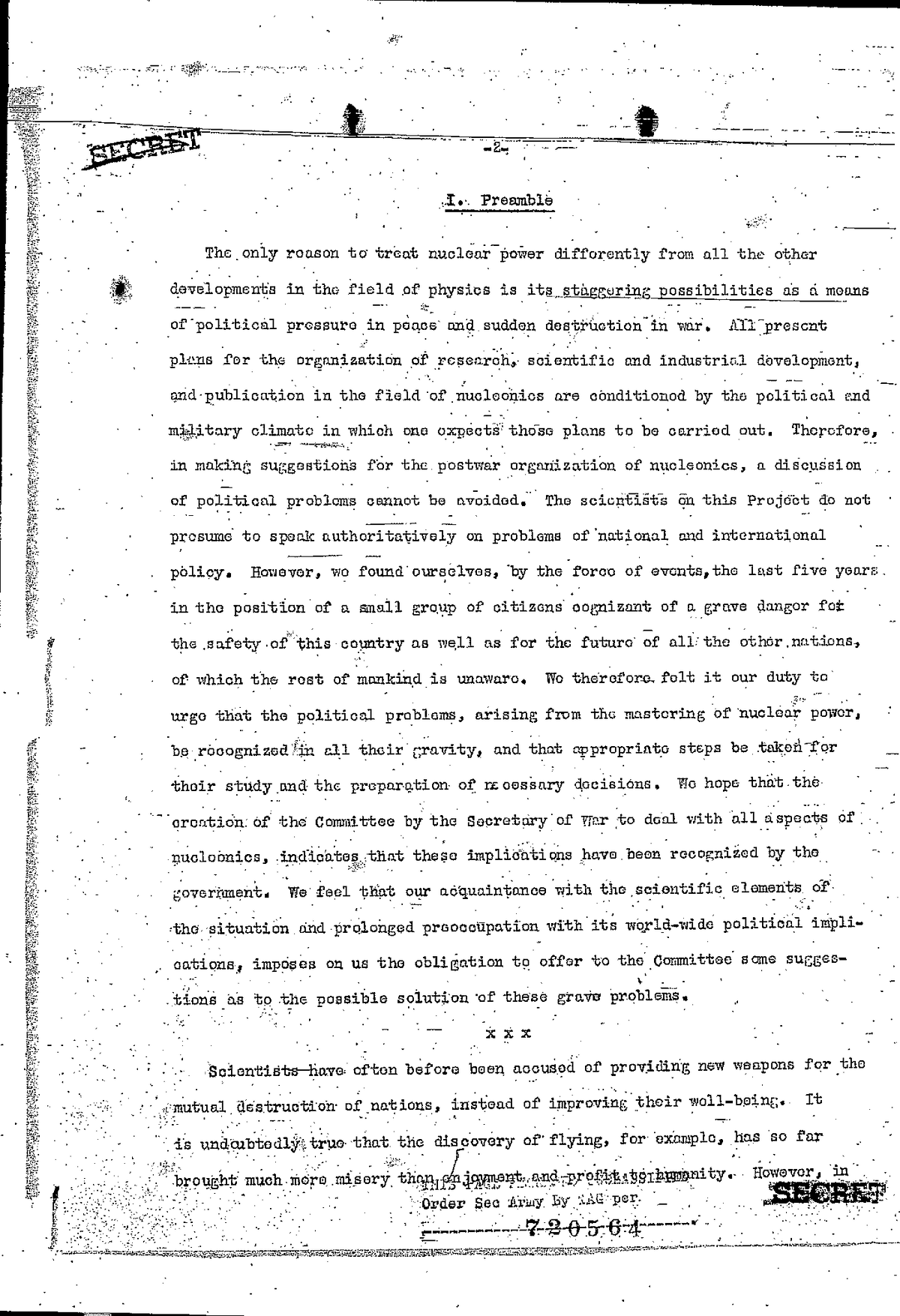
History rarely follows the hero archetypes, and the Manhattan Project provides an instructive example. Unlike the canonical myth that researchers stood up against using the bomb and were overruled by the generals, they were divided when the question of how to use the weapon became critical in June 1945. Two panels of researchers made different recommendations. The Franck Report urged a demonstration of the bomb’s power before a military drop. But a few days later, the Scientific Panel with Oppenheimer, Fermi, Compton and Lawrence concluded that no technical demonstration would end the war and instead recommended a direct military attack.
The researchers were not unified, and the state naturally relied on the panel which supported its own position. But on one vital point both panels were aligned: the Franck Report viewed the scientists’ special knowledge as a duty to warn of dangers and to inform public decisions, without claiming any authority over national policy. Likewise, the Scientific Panel did not claim any special competency to decide on the political, societal, or military questions. The underlying insight is still needed: knowing more about a technology gives us responsibilities toward other people (to inform, warn, or educate), not permission to determine their future.
It is just as easy to end up on the other side of this. Richard Feynman later recalled that von Neumann gave him the idea at Los Alamos “that you don’t have to be responsible for the world that you’re in.” Feynman wryly traced his own “social irresponsibility” to that advice.
“I am not sure even about myself”
At this point, it is tempting to turn history into a moral test: von Neumann remained, Rotblat left; and you decide how you want to be remembered. But Rotblat himself questioned this narrative. The following is not false modesty:
“I am not sure even about myself. Not being an absolute pacifist, I cannot guarantee that I would not behave in the same way, should a similar situation arise.”
—Joseph Rotblat, “Leaving the Bomb Project,” 1985
Rotblat, “Leaving the Bomb Project” (1985), concluding paragraphs. He was reflecting on how war had affected moral judgment, including his own decision to join the project.
In times of crisis, time pressure, group loyalty, and years of participation can distort moral judgment. Rotblat’s inference is that we should avoid having to deal with hard choices unprepared in the first place. Requiring an exceptional amount of courage to do the right thing is a sign of bad structures. Any governance plan that relies on solitary heroism at a pivotal moment is built to fail.
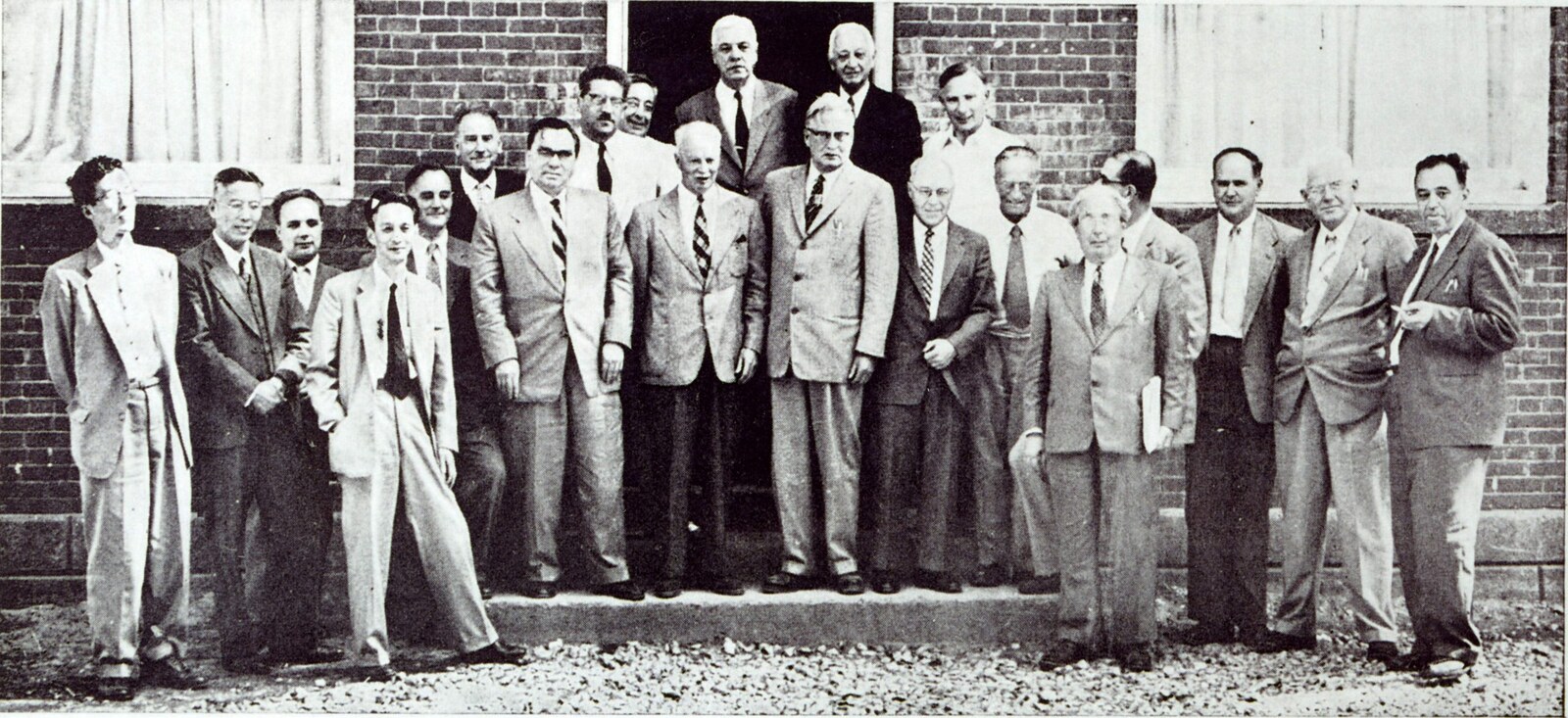
Rotblat’s life after Los Alamos tried to alleviate this. He shifted towards medical applications of radiation in his physics research, worked on educating the public, and spent decades building the Pugwash Conferences: starting in 1957, these were small recurring meetings with scientists from both sides in the Cold War who met in a personal capacity to push for nuclear disarmament across the Iron Curtain. In 1995, Rotblat and Pugwash shared the Nobel Peace Prize: not for his leaving Los Alamos, but for what he built afterwards.
Pre-register your conscience
We know that our judgments might become warped once the stakes rise, so we should not treat this as a question of willpower but as one of experimental design. We already know what happens when smart people are allowed to choose the hypothesis after seeing the results even when they try to remain honest: p-hacking. It is unlikely that we are somehow immune to p-hacking our own conscience. Instead, we should pre-register our moral thresholds and criteria, too, and then let somebody else peer-review them. This seems a more robust and falsifiable way to hold ourselves accountable.
But if frontier AI is in an international race between multiple labs, how can an individual researcher with a pre-registered stopping rule (or even a union at a single lab) change the global balance? Wouldn’t one lab with stricter internal oversight simply fall behind its less scrupulous competitors?
Sadly, yes. Neither personal scruples nor unionizing can halt the global race unilaterally. Yet what they provide is still indispensable. First, much of what goes wrong in labs has nothing to do with winning the AGI race: we have to worry about the slow erosion of safeguards, opaque military and surveillance deployments without sufficient oversight, and gag clauses and other chilling effects which keep the public in the dark. Second, democratic regulations and international agreements are impossible if citizens and governments are flying blind. External coordination requires that people inside the labs can speak up without risking their livelihoods.
I believe personal responsibility as an ordinary researcher comes down to three commitments:
First, choose what we focus our research and contributions on. Alignment, evaluations, interpretability, control and security are important research areas. Focusing on them can make a positive contribution, assuming we apply the same skepticism to safety research itself. The label we give research does not determine whether it actually reduces risks rather than being capabilities research in disguise, or smoothing out the path for faster deployment.
Second, commit to falsifiable personal thresholds and red lines with people who can hold you accountable. What concrete evidence (a capability threshold crossed without reliable control, a dropped safety pledge or AI principle, or a deployment without independent oversight) should make us switch projects or oppose a release? In the worst case, what would make us walk away?
A red line that we have not committed to in writing will keep shifting subconsciously as soon as it feels inconvenient without us realizing. Writing these criteria down and discussing them with trusted people who can tell us when we are shifting the goalposts is an effective protection against self-deception and rationalization.
Crucially, though, these trusted people should not be colleagues (and ideally not all work in AI). Homogeneity across working culture, competitive pressures, and similar career incentives might lead to red lines drifting together. Only independent peers outside our own bubble can help us preserve our original red lines.
The same holds for calls to slow down, by the way: when we ask for restraint, we also should know what evidence would prove to us that risks have become manageable.
Third, help dismantle the mechanisms that prevent and isolate dissent. According to Rotblat, when he asked to leave, Los Alamos intelligence produced an espionage dossier on him whose allegations collapsed because their details were easy to refute. Yet he was still forbidden from telling colleagues the moral reasons for leaving. Instead, he had to solely cite concerns about his wife in Poland, so his moral doubts would not unsettle anyone else.
The Right to Warn letter from 2024 shows that this is a contemporary problem. Current and former employees have asked for protection from retaliation, an end to gag clauses for risk-related criticism, and reliable anonymous reporting channels. Several current employees felt compelled to sign anonymously.
None of these steps requires a lone researcher to save the world by themselves, and yet even modest objections can be disproportionately costly. Researchers in frontier labs face very different financial, personal, health and immigration constraints. An honest debate about responsibility can neither pretend that walking away entails the same costs and trade-offs for everyone nor claim that going public is the only sensible action.
That is why I’ve been supporting collective organization in the field, including UTAW’s campaign at Google DeepMind.
Remember your humanity
In July 1955, the Russell-Einstein Manifesto asked its readers, whom it addressed simply as fellow humans, to set aside their institutional and national allegiances: “Remember your humanity, and forget the rest.” Forty years later, Rotblat closed his Nobel speech with the same call.
Billions of humans will never work in a frontier AI lab. Yet they will live in a world deeply impacted by the systems we build. Understanding what is happening right now better than the rest of the public presents us with serious obligations to our fellow humans and not the right to single-handedly gamble with their future.
In the age of AGI, we will not be short of intelligence. What we may be short of are people who recognize that their own judgments need guardrails, especially when they believe they are doing the most important work in the world.
I cannot resolve that question by picking the right role model, and leaving a single lab does not fix it either. Everyone who works in this field has to keep asking themselves: if our reasons for continuing turned out to be rationalizations, who would we trust to tell us honestly? And what have we built today that could actually change course later when it matters?
Thanks to everyone who has provided valuable feedback. Note: revised with LLM assistance for sourcing, structure, and correctness.